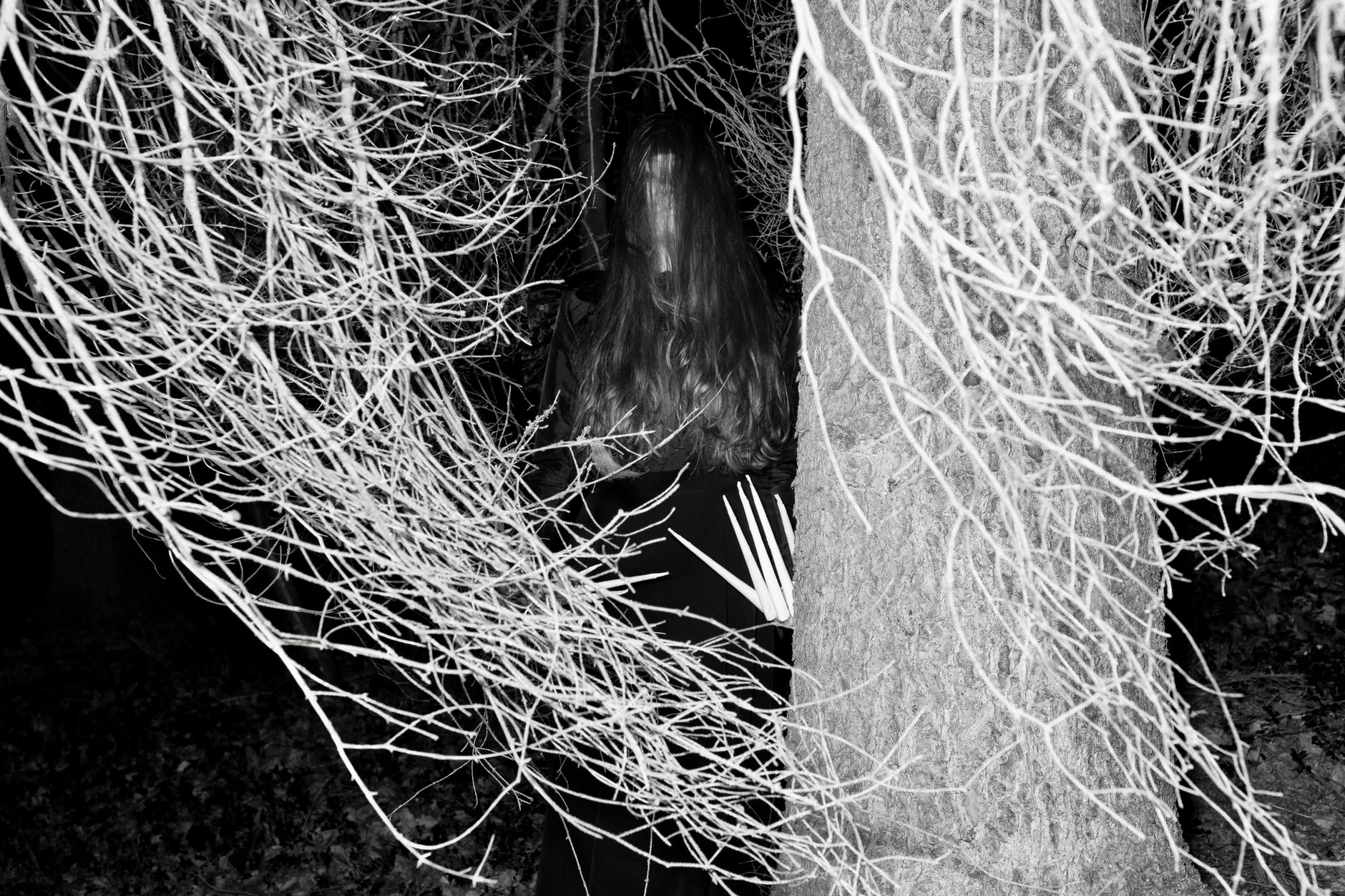
In *The Blair Witch Project* (1999), the scariest location is the one the camera never shows: the woods just outside the frame. Directors Daniel Myrick and Eduardo Sánchez built the film's horror out of offscreen space — the area a viewer knows exists around the image but cannot see — and then refused, for the entire running time, to let the camera turn far enough to resolve it.
That choice is why the film still unsettles audiences who find its handheld camcorder footage dated. The threat is never rendered, so it never becomes a costume, a prosthetic, or a design decision a viewer can rate. It stays exactly as frightening as the viewer's own imagination makes it.
Table of Contents
- What "offscreen space" means, and why this film is built on it
- How the camcorder format makes the frame feel narrow
- Sound does the work the image refuses to do
- The objects that prove something is out there
- The ending as the ultimate withheld frame
- What to watch for on a rewatch
- Frequently Asked Questions
What "offscreen space" means, and why this film is built on it
Offscreen space is a basic idea in film analysis: the world of a story extends past the four edges of the frame, and viewers automatically assume it's there. A character walks out of shot and we don't think they've stopped existing. Sound is the main tool for filling that space — a phone ringing in an unseen room, traffic outside a window.
Most horror films use offscreen space as a delay mechanism. Something is out there, the camera pans, and we finally see it. The payoff is the reveal, and the offscreen stretch is just the wind-up.
- Blair Witch* removes the second half of that structure. The camera pans toward the noise and finds trees. It finds nothing, over and over, until "nothing" becomes the film's most loaded image. The offscreen area is not a delay before the monster; it is where the monster permanently lives.
How the camcorder format makes the frame feel narrow
The film's found-footage conceit — the premise that we are watching recovered tapes shot by three missing student filmmakers — puts the camera inside a character's hands. That has a specific formal consequence: the frame can only look where a frightened person chooses to point it, and frightened people point cameras badly. Two format details do heavy work. The 16mm black-and-white and Hi8 video images are grainy and low-resolution, so even what's inside the frame resists being read clearly.
And the camera light falls off fast at night, turning the background into a hard wall of black roughly ten feet out. The result is a frame that feels physically small. Handheld footage also shakes, whip-pans, and loses focus, so the edges of the image are unstable. Offscreen space isn't a neat rectangle just beyond the border — it starts more or less at the character's fingertips.
Sound does the work the image refuses to do
Almost everything the audience "knows" about the threat arrives through sound coming from somewhere the camera isn't. Snapping branches. Children's voices at a distance. Something circling the tent while the campers lie inside, shouting at each other in the dark. Sound heard from an unseen source is more suggestive than an image because it carries direction and distance but no shape.
A viewer's brain fills in the shape, and it fills in the worst option available. That's not a gimmick specific to this film; it's why a creak on a staircase reads as scarier than a shot of the staircase. The night tent scenes are the clearest case. The screen is mostly black, the microphone is on, and the characters' panicked reactions tell us that whatever they can hear is close. The film gives the audience an audio event and a human response, and asks them to supply the middle term themselves.
The objects that prove something is out there
The film does show physical evidence, and this is what keeps the offscreen threat from feeling like nothing at all. The campers find stone piles outside their tent in the morning. They find the stick figures hanging from branches. Later, a bundle wrapped in cloth contains what appears to be human remains. These artifacts are important structurally.
They confirm intent — someone or something is deliberately arranging things near the camp — without confirming identity. The evidence points at an agent while describing none of its properties. That balance is delicate, and it's the part most imitators get wrong. Too little evidence and the audience concludes the characters are lost and hysterical. Too much and the threat acquires a body, a method, a set of rules. *Blair Witch* stops at the point where you believe something is there and can say nothing else about it.
The ending as the ultimate withheld frame
The final sequence in the house is the film's strictest application of its own rule. Heather runs through rooms with the camera swinging wildly, catching handprints on walls and fragments of doorway, while Mike's screams come from elsewhere in the building. Then she finds him standing in a corner, the camera drops, and the film ends. Nothing is shown attacking anyone.
The information the audience needs — what is behind the camera, what put Mike in that corner — is delivered as an absence. Even the corner image only means something if a viewer already knows the local legend mentioned earlier in the film, and the film doesn't restate it. This frustrates some viewers, and that reaction is fair rather than a failure of attention. A film that spends ninety minutes promising a reveal and then withholds it is making a trade: it gives up the satisfaction of resolution to keep the threat unresolvable. Whether that's worth it depends on what a viewer wants from horror.
What to watch for on a rewatch
The technique is easier to see once you're not tracking the plot. A second viewing rewards attention to where the camera is pointed rather than what it catches.
The limit worth naming: this approach depends on a film that can plausibly justify a small, badly aimed frame. Found footage supplies that justification cheaply, which is why the device spread so widely afterward. A conventionally shot, well-lit horror film with a mobile camera has to earn the same restriction some other way — through blocking, framing, or a deliberately narrow lens — and most don't try.
- Count the reveals. Track how many times a character turns the camera toward a sound and note what's actually in the resulting shot.
- Watch the frame edges at night. Note how much of the image is lit and how quickly the lit area ends.
- Separate what's seen from what's heard. Keep a mental list of threat information delivered by sound only versus by image.
- Note when the camera is running and when it isn't. The characters' decisions about filming determine what the audience is allowed to know.
- Compare the daylight and night scenes. Daylight sequences are largely interpersonal conflict; the supernatural pressure arrives almost entirely after dark.
Frequently Asked Questions
Is the Blair Witch ever shown on screen?
No. The 1999 film shows evidence of an agent — stone piles, stick figures, handprints, a bundle of remains — but never depicts a witch or any creature directly.
Does the ending explain what happened to Mike and Heather?
Not explicitly. The camera falls while Heather screams and the footage ends; the film offers no narration, epilogue, or confirmed account of their fate.
Why does the shaky camerawork matter to the horror rather than just being a style?
The instability keeps the frame's boundaries uncertain. A steady shot defines exactly what is and isn't visible; a lurching one makes even the visible area feel provisional.
Is offscreen space unique to found footage?
No. It's a standard tool in all filmmaking. Found footage simply provides a built-in excuse for a narrow, poorly aimed frame that a conventional camera would need to justify.