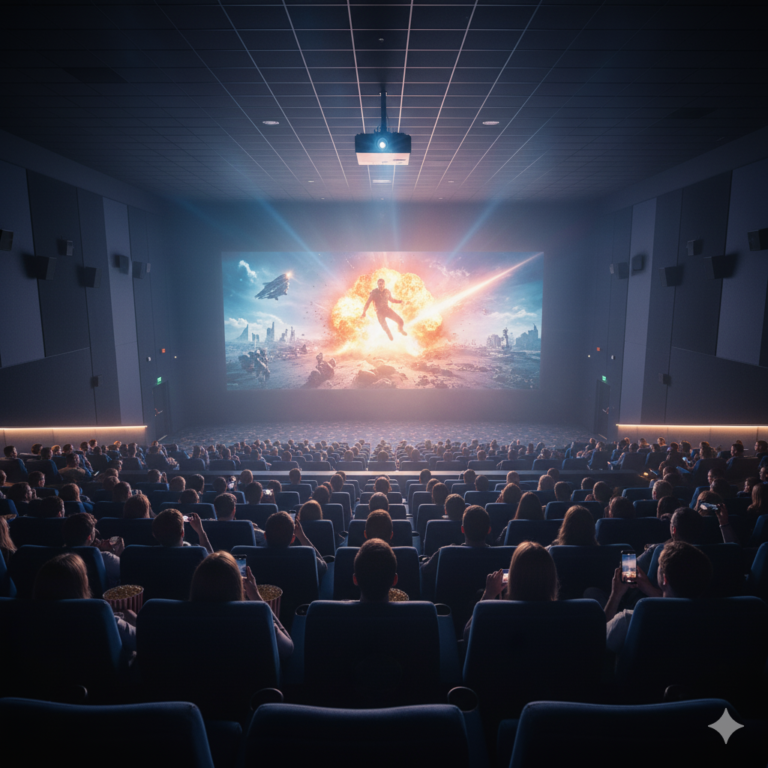
IMAX theaters display content using three primary aspect ratios: 1.43:1 (the native square-ish format for IMAX 70mm film), 1.90:1 (the current “Filmed for IMAX” standard), and 1.78:1 (an alternative expanded ratio used in select releases).
The aspect ratio you experience depends on both how a film was shot and which type of IMAX theater you’re in—a critical distinction that significantly impacts the visual presentation.
For instance, Christopher Nolan’s Dunkirk was shot in the native 1.43:1 IMAX format using 15/70mm film cameras, resulting in an image that fills more of the screen than a standard theatrical release.
This breakdown explores how different aspect ratios are used across popular films, why filmmakers choose specific formats, and what viewers actually see in different IMAX venues.
- Table of Contents
- What Are the Three Main IMAX Aspect Ratios?
- The Native 1.43:1 IMAX 70mm Format and Its Visual Advantage
- Understanding the Modern 1.90:1 "Filmed for IMAX" Standard
- How Do IMAX Aspect Ratios Compare to Standard Cinema?
- Theater System Capabilities and How They Affect What You See
- The Expanding Catalog of "Filmed for IMAX" Productions
- The Future Direction of IMAX Aspect Ratio Standards
- Frequently Asked Questions
- You Might Also Like
Table of Contents
- What Are the Three Main IMAX Aspect Ratios?
- The Native 1.43:1 IMAX 70mm Format and Its Visual Advantage
- Understanding the Modern 1.90:1 “Filmed for IMAX” Standard
- How Do IMAX Aspect Ratios Compare to Standard Cinema?
- Theater System Capabilities and How They Affect What You See
- The Expanding Catalog of “Filmed for IMAX” Productions
- The Future Direction of IMAX Aspect Ratio Standards
- Frequently Asked Questions
What Are the Three Main IMAX Aspect Ratios?
imax theaters operate with three distinct aspect ratio standards, each with different technical requirements and visual impacts.
The 1.43:1 ratio is the native format for IMAX 15/70mm film cameras—essentially a nearly square frame that maximizes vertical screen real estate.
The 1.90:1 ratio represents the modern “Filmed for IMAX” standard, sitting between the traditional 35mm theatrical standard of 1.85:1 and true IMAX proportions, making it slightly wider than standard cinema. The 1.78:1 ratio serves as an intermediate option, used in select IMAX releases that fall between standard scope and full IMAX proportions.
The choice between these formats involves significant production planning. Shooting in native 1.43:1 requires specialized IMAX 70mm cameras and is dramatically more expensive than standard digital cinematography.
Filmmakers like Denis Villeneuve (Dune) and Christopher Nolan (Dunkirk, Oppenheimer) have invested in native IMAX photography specifically to deliver the immersive experience that comes with the nearly square 1.43:1 ratio.
The newer 1.90:1 “Filmed for IMAX” standard has emerged as a compromise—allowing filmmakers to capture additional vertical information for IMAX screens without the extreme production costs of full 70mm IMAX cameras.

The Native 1.43:1 IMAX 70mm Format and Its Visual Advantage
The 1.43:1 aspect ratio represents the truest IMAX experience because it’s the native format of IMAX 15/70mm film cameras. However, this format presents a significant limitation: it’s only available in select theater locations.
IMAX Laser GT and 70mm IMAX GT theaters can display content at the full 1.43:1 ratio, but many standard IMAX locations use laser projection systems that may display content at different aspect ratios.
If you’re watching Oppenheimer or Tenet at a regular IMAX theater, you might not experience the full 1.43:1 format—your venue may be scaling the content to fit its specific system.
The visual advantage of 1.43:1 is quantifiable: this format delivers approximately 40% more image area than the scope aspect ratio of 2.39:1, which is standard for action and sci-fi films on regular screens.
This means IMAX directors can frame shots with significantly more headroom and floor space, emphasizing scale and environmental storytelling in ways impossible on conventional screens.
When you watch Dune in a true IMAX 1.43:1 theater, the desert landscapes don’t just fill the width of the screen—they extend dramatically upward and downward, immersing the viewer in vast planetary vistas that would be impossible to experience in scope format.
Understanding the Modern 1.90:1 “Filmed for IMAX” Standard
The 1.90:1 “Filmed for IMAX” standard has become the most practical way for major productions to capture IMAX-enhanced visuals without the production constraints of 70mm film.
Upcoming releases like Superman (2025), Dune: Part Three (2026), and The Odyssey (2026) are being shot or composed specifically for 1.90:1 IMAX presentation, using modern digital cinematography or traditional film stock adapted for this wider ratio.
This format allows cinematographers to compose shots with additional vertical information that takes advantage of IMAX’s expanded vertical dimension without requiring the massive format cameras.
The critical distinction is that “Filmed for IMAX” productions are compositionally designed with IMAX screens in mind from pre-production through shooting, rather than being reformatted after the fact.
F1: The Movie and How to Train Your Dragon (both 2025) are being produced natively for the 1.90:1 format, meaning every frame is intentionally composed to make best use of IMAX theaters’ capabilities.
When you see these films in an IMAX theater, you’re experiencing the director’s intended framing—however, if you watch them on a standard theatrical screen or streaming platform, you’ll miss significant portions of the top and bottom of the frame that were specifically composed for IMAX audiences.

How Do IMAX Aspect Ratios Compare to Standard Cinema?
The visual difference between IMAX aspect ratios and standard theatrical formats is more dramatic than most casual moviegoers realize. A typical theatrical release uses either 1.85:1 (standard) or 2.39:1 (scope/anamorphic), both of which are significantly wider than they are tall.
IMAX’s 1.43:1 ratio inverts this proportion—it’s actually taller than it is wide, fundamentally changing how directors compose visual information and how audiences experience the image. Standard scope at 2.39:1 emphasizes horizontal spectacle; IMAX 1.43:1 emphasizes vertical scale and depth.
The 1.90:1 “Filmed for IMAX” standard provides a middle ground—wider than native IMAX but offering more vertical real estate than standard theatrical formats. This explains why major action and sci-fi films have increasingly adopted “Filmed for IMAX” production workflows.
Avatar: The Way of Water expanded audiences’ familiarity with IMAX presentation, and that success has led studios to invest in IMAX-optimized productions. The tradeoff is that these format-specific compositions sometimes appear awkwardly framed when shown on standard screens, with unused space at the edges or information that extends beyond visible frame lines.
Theater System Capabilities and How They Affect What You See
Not all IMAX theaters are created equal, and the aspect ratio you experience depends entirely on the venue’s projection system. IMAX Laser GT systems use dual projectors capable of displaying content at the full 1.43:1 native ratio, providing the most immersive experience for films shot in that format.
Other IMAX locations equipped with different laser systems may display the same film at a wider but shorter 1.90:1 or even different ratios depending on their technical specifications.
This creates a genuine limitation for viewers: there’s no reliable way to know before purchasing tickets whether your local IMAX theater will display a film in its native aspect ratio. Dunkirk in a true IMAX 70mm theater is a dramatically different experience than Dunkirk in a standard IMAX location.
Serious IMAX enthusiasts have learned to research their local venues’ equipment specifications before planning viewing experiences for major releases. The increasing adoption of “Filmed for IMAX” over native 70mm partly reflects studios’ recognition that true 70mm IMAX venues represent a shrinking percentage of IMAX locations worldwide.

The Expanding Catalog of “Filmed for IMAX” Productions
The 2025-2026 theatrical slate reveals a significant industry shift toward “Filmed for IMAX” production. Superman (2025), How to Train Your Dragon (2025), and F1: The Movie (2025) are all entering theaters with IMAX-optimized compositions.
Looking further ahead, Dune: Part Three is being shot with IMAX cameras, and The Odyssey (2026) represents the first feature film shot entirely with IMAX film cameras—a landmark moment in the format’s evolution.
Beyond these announced titles, studios have confirmed 12 additional 2026 releases in the “Filmed for IMAX” program, indicating sustained industry investment in the format. This expansion reflects both technical innovation and market response.
Digital IMAX systems and IMAX Laser technology have made producing and distributing “Filmed for IMAX” content more practical than maintaining expensive 70mm infrastructure. Filmmakers recognize that audiences respond to the immersive experience IMAX offers, making the format investment worthwhile for tentpole productions.
The Future Direction of IMAX Aspect Ratio Standards
The trajectory of IMAX aspect ratio evolution suggests that “Filmed for IMAX” at 1.90:1 will increasingly become the de facto standard for major productions, while native 1.43:1 70mm production remains the exclusive province of auteur filmmakers like Christopher Nolan who prioritize format fidelity above production cost considerations.
The Odyssey’s distinction as the first film shot entirely with IMAX cameras indicates that studios are willing to invest in native IMAX production when the story and scale justify the expense.
Looking ahead, viewers should expect IMAX aspect ratio decisions to become transparent decision points in major film announcements. Studios marketing “Filmed for IMAX” productions are signaling technical differentiation that has measurable impact on the theatrical experience.
Whether shooting in 1.90:1 or the native 1.43:1 format, filmmakers increasingly see IMAX composition as a fundamental creative choice rather than a post-production optimization.
Frequently Asked Questions
Why do some films shot for IMAX show differently in different theaters?
IMAX theaters use different projection systems with varying aspect ratio capabilities. IMAX Laser GT and 70mm IMAX GT locations can display native 1.43:1 content, while other IMAX theaters may display the same film at 1.90:1 or different ratios depending on their equipment. Your local venue’s technical specifications determine the experience you actually see.
What’s the difference between “filmed for IMAX” and “shot with IMAX”?
“Filmed for IMAX” means the production was compositionally designed for IMAX screens using standard cinematography equipment. “Shot with IMAX” (or films shot entirely with IMAX cameras) means they used actual IMAX cinema cameras, typically the native 1.43:1 70mm format. The Odyssey (2026) is the first film shot entirely with IMAX cameras.
Will I see the full IMAX experience watching these films on streaming platforms?
No. Streaming platforms and standard theatrical releases are significantly cropped to fit 16:9 or 2.39:1 formats. You’ll lose substantial portions of the top and bottom of the frame that were specifically composed for IMAX screens, particularly with films shot in the native 1.43:1 ratio.
How much larger is a 1.43:1 IMAX image compared to a standard scope film?
The 1.43:1 IMAX format delivers approximately 40% more image area than the standard scope aspect ratio of 2.39:1. This dramatic size difference is why IMAX presentations feel immersively larger and why compositions created for IMAX significantly emphasize vertical scale.
Why don’t all IMAX films use the native 1.43:1 format?
Native 1.43:1 production requires specialized 70mm IMAX cameras and film stock, dramatically increasing production costs. The 1.90:1 “Filmed for IMAX” standard achieves much of the visual benefit using standard cinematography, making it more economically practical for most productions.
You Might Also Like
- How IMAX Aspect Ratio Changes Film Experience
- What IMAX Aspect Ratio Means For Movie Viewing
- IMAX Aspect Ratio Explained With Examples From Movies