IMAX aspect ratios fundamentally transform the film viewing experience by expanding the visible image area far beyond standard cinema formats, with the iconic 1.43:1 ratio delivering approximately 67% more picture than traditional CinemaScope, and the more common 1.90:1 digital format providing around 26% additional screen real estate.
When you sit in an IMAX theater, particularly one equipped with the taller 1.43:1 framing, the expanded vertical space creates a sense of immersion and grandeur that pulls more of your peripheral vision into the action—a sequence shot in this format appears not just larger but fundamentally different in composition, with filmmakers intentionally crafting scenes to take advantage of that extra vertical breathing room.
This article explores how these wider aspect ratios alter cinematography, audience psychology, theater engineering, and the filmmaking process itself, while examining the rapidly evolving IMAX landscape as major directors return to the format with new releases planned through 2026.
- Table of Contents
- What Are IMAX Aspect Ratios and How Do They Compare?
- How Aspect Ratio Shapes Visual Storytelling and Composition
- The Theater Experience and Screen Engineering
- The Business Case for IMAX's Aspect Ratio Expansion
- Recent Developments and the IMAX 70mm Renaissance
- Aspect Ratio Decisions Across IMAX's Digital and Film Formats
- The Future of IMAX Aspect Ratios and Filmmaking
- Conclusion
- You Might Also Like
Table of Contents
- What Are IMAX Aspect Ratios and How Do They Compare?
- How Aspect Ratio Shapes Visual Storytelling and Composition
- The Theater Experience and Screen Engineering
- The Business Case for IMAX’s Aspect Ratio Expansion
- Recent Developments and the IMAX 70mm Renaissance
- Aspect Ratio Decisions Across IMAX’s Digital and Film Formats
- The Future of IMAX Aspect Ratios and Filmmaking
- Conclusion
What Are IMAX Aspect Ratios and How Do They Compare?
The imax ecosystem uses two primary aspect ratios that directly shape what you see on screen.
The traditional IMAX 1.43:1 ratio, available in select venues worldwide, employs a more square, vertically oriented frame compared to standard cinema’s 2.39:1 CinemaScope, resulting in that distinctive tall screen experience.
The more widely available IMAX 1.90:1 ratio, used in most IMAX Digital installations that rely on dual 2K digital projectors, occupies a middle ground between standard multiplex formats and the full-height experience.
To put these differences in concrete terms: if a standard CinemaScope image fills a certain width and height, the 1.43:1 IMAX frame increases the visible area by roughly 67%, while the 1.90:1 digital format adds approximately 26% more picture.
This isn’t merely a matter of watching the same film at a different size—it’s a fundamental reshaping of composition that directors must account for during production.
The technical foundation underlying these ratios traces back to IMAX’s 70mm film format, which uses film frames measuring roughly 70mm by 48.5mm, more than twice the dimensional size of traditional 35mm cinema film. This enormous format yields an estimated 12K resolution when projected, enabling the extraordinary clarity that defines the IMAX experience.
Standard IMAX screens measure 18 by 24 meters (59 by 79 feet), creating a visual canvas that produces an image area approximately 8.3 times larger than 35mm film and 3.4 times larger than 70mm film run in a vertical orientation.
However, a crucial limitation exists: fewer than 30 theaters globally can actually project the full 70mm IMAX format, so most audiences encounter the 1.90:1 digital version, which uses the same theatrical setup but operates through dual 2K digital projection systems rather than physical film.

How Aspect Ratio Shapes Visual Storytelling and Composition
When cinematographers frame a shot for 1.43:1 IMAX, they’re composing for a fundamentally different visual language than standard widescreen cinema. The vertical emphasis of IMAX’s taller ratio invites filmmakers to use height compositionally—placing characters or architectural elements along vertical lines that would feel awkward in the squatter CinemaScope frame.
Consider an action sequence in an IMAX theater: the extra vertical space allows stunt coordinators and editors to show both overhead and ground-level elements simultaneously, creating a more comprehensive spatial geography that enhances the sense of scale.
When filmed in 1.43:1, movies show up to 26% more image in key scenes, making sequences appear taller, grander, and more “open”—an effect that can elevate dramatic moments or amplify the spectacle of large-scale set pieces.
However, this expanded framing introduces a significant production constraint that many directors avoid entirely. Not all content suits IMAX’s vertical emphasis; intimate dialogue scenes, close-ups of faces, and compositions designed around horizontal lines can feel oddly stretched or off-balance when forced into the taller ratio.
If a director frames a scene for standard 2.39:1 cinema and that film later gets reformatted for IMAX, the result often appears to have empty space above and below the action, breaking the intended visual rhythm.
This is why Christopher Nolan’s upcoming film “The Odyssey” (July 2026) represents a watershed moment: it marks the first theatrical feature shot completely on IMAX 70mm film from start to finish, rather than being shot for standard cinema and later adapted.
This full-commitment approach ensures every frame, every compositional choice, and every camera movement accounts for IMAX’s distinctive proportions from the moment of conception.
The Theater Experience and Screen Engineering
The IMAX aspect ratio advantage extends beyond the simple mathematical increase in image area—it requires entirely different theater architecture to achieve its intended effect.
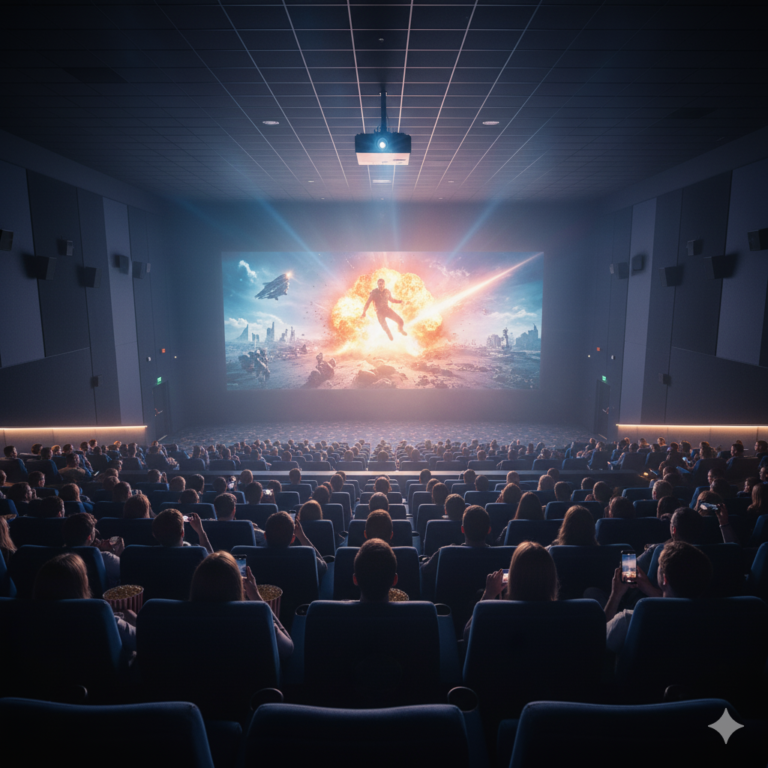
IMAX venues are engineered with steeper seating levels that tilt audiences upward toward the massive curved screens, which cover more of each viewer’s field of vision compared to standard multiplex theaters.
This curvature and elevation create an immersive envelope that pulls peripheral vision into the frame, making the wider aspect ratio feel more enveloping rather than simply sprawling.
The combination of IMAX laser projection—which delivers enhanced brightness and clarity compared to standard digital cinema projectors—completes the sensory package, ensuring that the additional screen real estate actually translates to superior image quality rather than merely spreading the same amount of light across a larger area.
This engineering excellence explains why seeing a film in a proper IMAX venue produces such a distinctly different experience from watching it in a standard theater, even when the film itself was shot in standard cinema formats. The infrastructure is optimized specifically for those aspect ratios and the theatrical geometry they require.
Yet this creates an uneven viewing landscape: audiences in major metropolitan markets with dedicated IMAX locations experience films as intended, while those in regions without nearby IMAX theaters see the same film in a completely different aspect ratio and theatrical context.
A film shot with IMAX cameras and composed for the 1.43:1 ratio will be reformatted to 2.39:1 or even 1.85:1 for standard releases, fundamentally altering the director’s original creative intent.

The Business Case for IMAX’s Aspect Ratio Expansion
The financial success of IMAX demonstrates that audiences actively prefer the experience provided by these expanded aspect ratios, voting with their ticket purchases and higher admission prices.
In 2025, IMAX generated a record $1.28 billion at the global box office, marking a remarkable 40% increase over 2024, while IMAX stock jumped 44% or more throughout that year. This growth reflects not only the format’s traditional strongholds in action blockbusters but also expanding adoption by prestige filmmakers and across diverse genres.
Audiences are willing to pay premium prices specifically for the IMAX experience—often $5 to $8 more per ticket than standard cinema—because the aspect ratio, combined with the larger screens and superior technology, fundamentally changes how they perceive the film.
From a practical standpoint, this financial momentum is driving decisions about which films to shoot in IMAX formats and which to reserve for standard releases.
The economic calculation has shifted: a major studio production budgeted at $200 million can justify shooting in IMAX when market data shows that audiences will actively seek out IMAX screenings, driving higher per-theater averages. However, producers must also account for the distribution complexity created by multiple aspect ratios.
A film shot in 1.43:1 IMAX must be cropped and reformatted for streaming platforms, television broadcasts, and home video, each requiring different compositional compromises. The tradeoff between maximizing theatrical impact and managing post-release distribution challenges represents a genuine tension in modern filmmaking.
Recent Developments and the IMAX 70mm Renaissance
The most significant recent development in IMAX aspect ratio evolution is the planned return of full-65mm/70mm production, with “The Odyssey” as the flagship example.
Christopher Nolan’s decision to shoot this film entirely on IMAX 70mm represents the first theatrical feature to commit fully to the format throughout production, rather than hybrid approaches where some sequences use 70mm and others use standard cinema.
This decision carries profound implications for the aspect ratio conversation: it signals that major contemporary filmmakers believe IMAX’s 1.43:1 framing—with its distinctive vertical emphasis—is worth the considerable production complexity and expense of shooting on physical film in 2026.
However, this renaissance faces a critical limitation: the shortage of projection capabilities. Fewer than 30 theaters worldwide can project genuine 70mm IMAX, meaning “The Odyssey” and subsequent IMAX-native productions will reach only a fraction of global audiences in their intended format.
Forthcoming releases including “Star Wars: The Mandalorian and Grogu,” “Narnia,” and “Dune: Part Three” are all being shot with IMAX film cameras, but most will still need to be reformatted for the 1.90:1 digital IMAX format and standard cinema for wide release.
This limitation underscores a critical reality: while IMAX aspect ratios transform the viewing experience for those who can access them, the technology’s impact remains geographically constrained, affecting filmmaking decisions despite serving only a small percentage of the global audience.

Aspect Ratio Decisions Across IMAX’s Digital and Film Formats
The choice between 1.43:1 and 1.90:1 aspect ratios involves distinct tradeoffs for filmmakers and exhibitors. The traditional 1.43:1 ratio maximizes the IMAX experience and is available only in dedicated IMAX 70mm theaters, limiting its deployment to prestige productions and major franchise events.
The 1.90:1 digital ratio, used in standard IMAX Digital locations with dual 2K projectors, offers broader distribution—potentially hundreds of theaters worldwide can project 1.90:1 content—while still delivering approximately 26% more visible image than standard CinemaScope.
For most filmmakers, the 1.90:1 ratio represents the practical sweet spot: it’s accessible to significantly more audiences, requires less specialized theater infrastructure, and still provides substantial compositional advantages over standard cinema.
Productions shooting specifically for IMAX often default to the 1.90:1 ratio because it reaches the maximum number of audience members without demanding the extraordinary rarity of 70mm projection capabilities.
This pragmatic choice also simplifies the post-release reformatting process, as 1.90:1 imagery crops less awkwardly when adapted for standard 2.39:1 presentations than the more vertically extreme 1.43:1 ratio does.
The Future of IMAX Aspect Ratios and Filmmaking
The 2025-2026 period represents an inflection point for IMAX aspect ratios in cinema history.
The convergence of several factors—record box office performance, major directors committing to IMAX production, and announced slate of IMAX-native films through 2026—suggests that aspect ratio considerations are returning to the center of directorial intent in ways that seemed unlikely a decade ago.
Nolan’s “The Odyssey” is scheduled for July 2026, effectively serving as a proof-of-concept for contemporary filmmaking at full IMAX specifications, while the pipeline of Star Wars, Narnia, and Dune projects indicates that major franchises are willing to invest in the format despite its distribution constraints.
Yet the expansion of IMAX’s market reach still depends on theater upgrades and new installations supporting the format, a capital-intensive process that develops slowly outside major metropolitan markets.
If the IMAX renaissance accelerates, future audiences may gradually gain access to more venues capable of projecting these distinctive aspect ratios, fundamentally altering how films are composed and experienced on a global scale.
Conclusion
IMAX aspect ratios—whether the iconic 1.43:1 or the more accessible 1.90:1 digital format—fundamentally reshape the film viewing experience by expanding the visible image area by 26% to 67% compared to standard cinema, creating visual canvases that invite different compositional approaches, stronger immersive theater engineering, and deliberate storytelling choices specific to that expanded vertical space.
The 2025 box office surge, record IMAX revenues, and announced production slate including Nolan’s “The Odyssey” demonstrate that audiences and filmmakers both value these formats, despite the technical and distributional complexity they introduce.
For filmgoers, understanding IMAX aspect ratios explains why the same film can feel dramatically different depending on the venue—and why seeking out proper IMAX presentations of films shot with those ratios in mind genuinely matters for experiencing cinema as the director intended.
For the industry, the current moment represents an opportunity to further integrate IMAX’s distinctive aspect ratios into mainstream filmmaking, though practical constraints around theater availability suggest that this transformation will remain uneven across global markets for the foreseeable future.
You Might Also Like
- What IMAX Aspect Ratio Means For Movie Viewing
- IMAX Aspect Ratio Explained With Examples From Movies
- IMAX Screen Ratio Differences Compared To Standard Formats