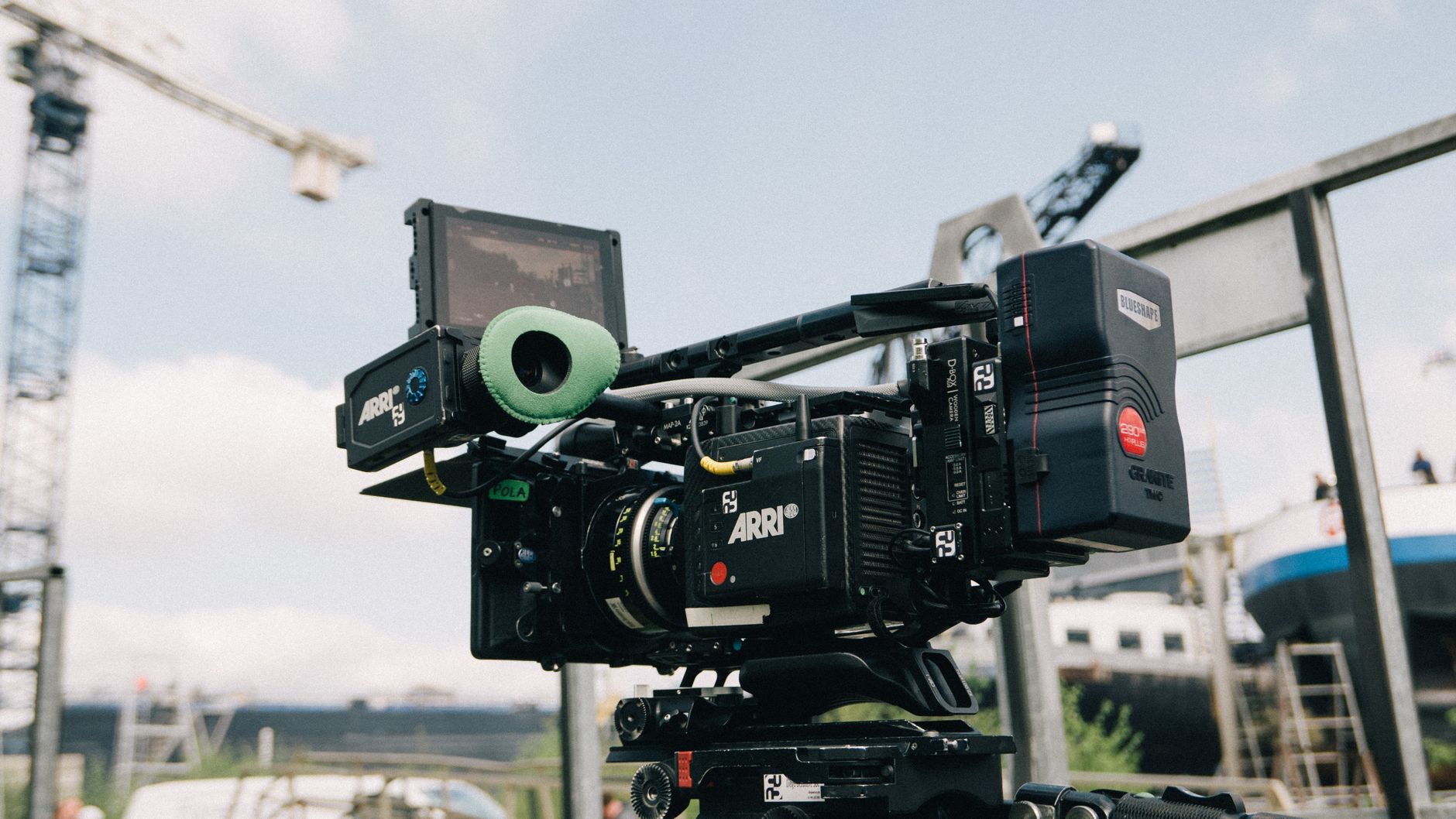
A Steadicam is a body-mounted camera stabilizer, invented by cameraman Garrett Brown in the 1970s, that lets an operator walk, run, or climb stairs while the camera glides as smoothly as if it were on rails. It survives in an age of cheap electronic gimbals because it keeps a trained human in the loop: the operator can reframe, lead an actor, and make split-second choices that a motorized rig does not make on its own. The system works by isolating the camera from the operator's body. A vest carries the weight into the hips, an articulated arm absorbs the bounce of footsteps, and a sled balances the camera against a counterweight so it floats in whatever attitude the operator nudges it into.
Table of Contents
- How the three parts actually work
- What a Steadicam shot does that a dolly or handheld cannot
- Steadicam versus electronic gimbals
- What the operator is doing, and why it is a specialty
- Recognizing the shot, and when not to use it
- Frequently Asked Questions
How the three parts actually work
The vest is the foundation. It takes the full load — camera, lens, batteries, monitor, counterweights — off the arms and shoulders and transfers it to the torso and pelvis, which is why operators can carry setups far heavier than anyone could hand-hold. The iso-elastic arm is the part that does the smoothing. Springs inside it extend and compress as the operator's body rises and falls with each stride, converting vertical bounce into horizontal travel.
"Iso-elastic" means the arm holds roughly the same lifting force across its range of motion, so the camera does not sink at the bottom of a step or spring upward at the top. The sled holds the camera at one end and the battery and weights at the other, with a gimbal in the middle near the balance point. Because the mass is spread out along the post, the whole assembly resists sudden rotation — the same reason a long pole is easier to hold level than a brick. The operator steers it with fingertips on the gimbal handle, which is why the touch is often described as closer to guiding than gripping.
What a Steadicam shot does that a dolly or handheld cannot
A dolly gives perfectly smooth movement but needs track, a flat floor, and a crew to lay and level it. A Steadicam goes anywhere a person can walk: up a staircase, through a doorway, into a car, across rubble, down a hallway that turns three times. That freedom is the whole point of the long unbroken shots the tool is famous for. Handheld does the opposite. It goes anywhere too, but it reads as unstable, and that instability becomes the subject — urgency, panic, documentary immediacy.
Steadicam separates mobility from nervousness. The audience feels motion without feeling the operator. The difference shows up in how shots get written. A single Steadicam take can introduce a space, follow a character into it, meet three other characters, and end on a close-up, all without a cut. Built from dolly shots, the same sequence would need coverage, relighting, and edits that break the continuity the director wanted in the first place.
Steadicam versus electronic gimbals
Three-axis motorized gimbals — the handheld and vest-mounted stabilizers now common on sets of every budget — use motors and sensors to hold the camera level. They are cheaper, lighter, faster to balance, and much easier to learn.
For many jobs they have genuinely replaced a Steadicam. The trade-offs are real, though, and they are why productions still book Steadicam operators:.
- Motors enforce level. A gimbal fights deliberate tilts and roll, so dynamic reframing mid-move can feel like wrestling the rig.
- Payload and lens size. A big cinema camera with a long zoom, follow focus, and matte box pushes past what smaller gimbals carry comfortably.
- Framing authority. On a Steadicam the operator's hand is the stabilizer's input; the frame responds immediately rather than through a control loop.
- Battery and failure modes. A mechanical arm does not run out of charge or lose calibration mid-take.
- Hybrid rigs exist. Many operators mount a gimbal head on a Steadicam vest and arm, taking the body support from one system and the leveling from the other.
What the operator is doing, and why it is a specialty
Steadicam operating is a distinct craft, credited separately from the camera operator on most features. The operator carries a loaded rig for hours, walks backward through marked paths without looking, keeps a frame composed while moving, and coordinates with a focus puller who is adjusting lenses wirelessly on a subject whose distance changes continuously. Balance is a setup task with no shortcut.
Static balance means the camera stays in whatever attitude it is set to; dynamic balance means it does not drift when the sled spins. Getting both right takes time with weights and trim adjustments, and an out-of-balance rig fights the operator for the whole shoot day. The physical cost shapes scheduling. Rigs commonly run into the tens of pounds once a cinema camera and accessories are attached, so takes are planned around how long an operator can stay in the vest, and assistants help carry the load between setups.
Recognizing the shot, and when not to use it
The signature is a camera moving fluidly at roughly human height, holding on a subject while the background slides past, with none of the small jitter of handheld and none of the mechanical straightness of a dolly. Long walk-and-talks through offices and corridors, a camera leading a character through a crowd, and a continuous descent down stairs are the common cases. It is the wrong tool more often than enthusiasm suggests.
A static dialogue scene gains nothing from floating. Very slow, very precise moves often read better on a dolly, where the operator is not also managing their own footsteps. Tight interiors with no clear path, or a shot that must land on an exact mark repeatedly, can favor a dolly or a motion-control rig. Anyone deciding between options can work through it quickly:.
- Does the camera need to go where track cannot be laid? Consider a Steadicam or gimbal.
- Does the shot need constant creative reframing while moving? That favors a Steadicam.
- Is the camera package heavy with accessories? That favors a vest-and-arm system.
- Does the shot need to repeat identically? Consider a dolly or motion control.
- Is instability part of the point? Shoot it handheld instead.
Frequently Asked Questions
Is Steadicam a brand name or a general term?
It is a trademarked product line, though the word is widely used on sets as shorthand for any vest-and-arm stabilizer. Credits and rental orders usually mean the specific system.
Can one person operate a Steadicam alone?
Operating it is one person's job, but a focus puller handles lens changes during the move, and assistants typically help with balancing and carrying the rig between takes.
Does a Steadicam eliminate camera shake completely?
No. It removes the bounce and jitter of footsteps, but a skilled operator's small residual motion remains, and that slight organic drift is part of why the look reads as alive rather than mechanical.