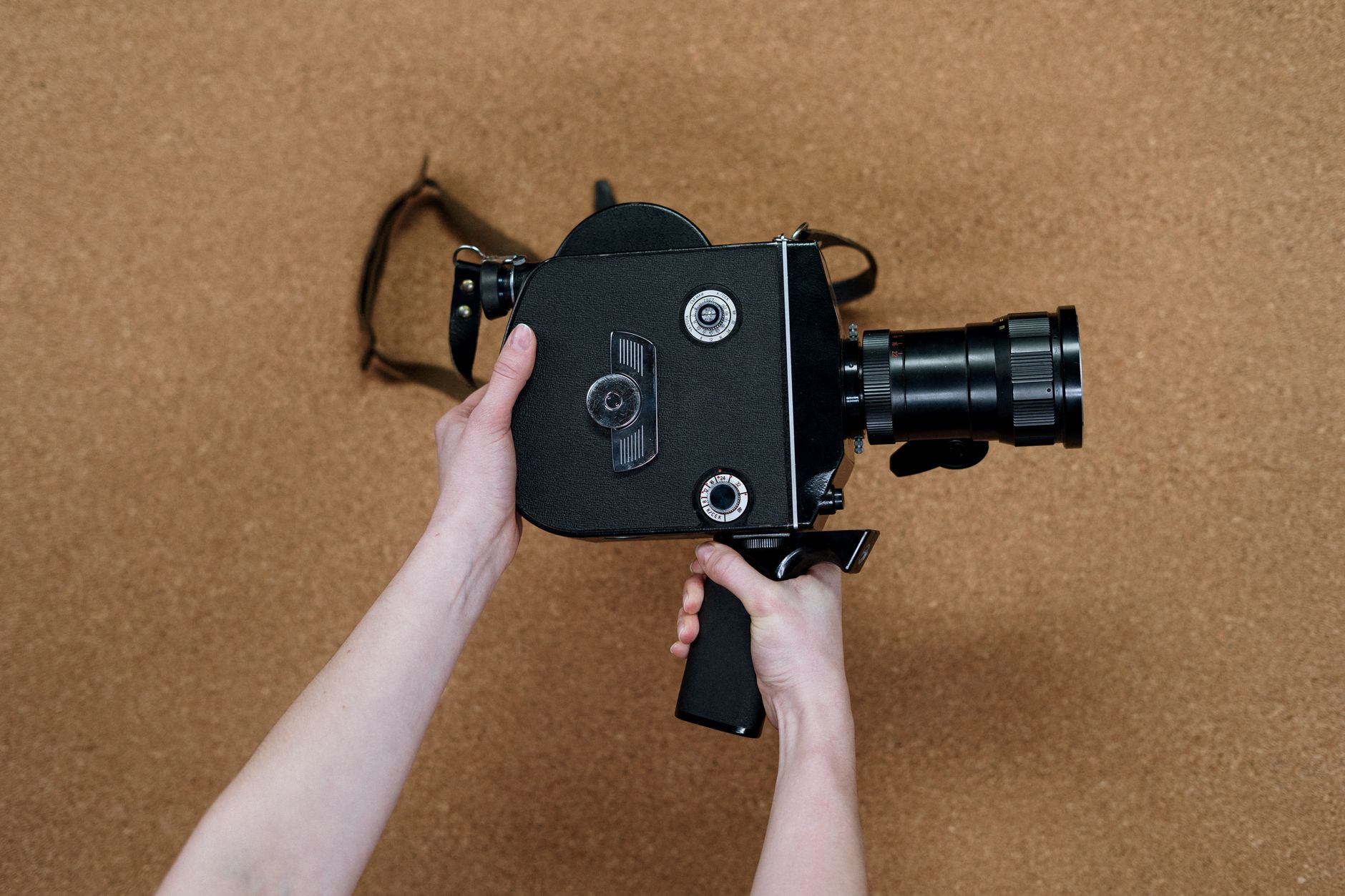
A film camera is a light-tight box that records images on chemical film instead of a digital sensor. It works by opening a shutter for a fraction of a second so the lens can project light onto that film. Film means a flexible strip coated with tiny crystals that react to light. Each burst of light records one still picture, and thousands of those pictures in sequence become a movie.
Table of Contents
- What happens when you press the button?
- How does film store the picture?
- What do the lens and shutter control?
- How do still pictures become motion?
- Why does film look different from digital?
What happens when you press the button?
Light bounces off the scene and enters through the front lens. The lens focuses those rays into a sharp image at the back of the camera, where the film waits behind the shutter. When you press the button, two things move in quick order.
The mirror flips up out of the light path in many designs, then the shutter opens and closes. That brief opening is the exposure. Think of the path in order:.
- lens gathers and focuses light
- aperture narrows or widens the beam
- shutter times the exposure
- film stores the image as chemical change
How does film store the picture?
The coating on film is called emulsion. It holds microscopic crystals that change when struck by photons, which are tiny packets of light. Brighter areas of the scene change more crystals. Darker areas change fewer.
This invisible pattern is the latent image. Chemical development makes that pattern visible. One common process turns the exposed film into a negative, where light and dark are reversed. Printing or scanning reverses it again into a normal positive image.
What do the lens and shutter control?
The lens controls focus and framing. Turning the focus ring moves glass elements so the subject looks sharp. Changing the lens changes how wide or tight the view feels. The aperture is an adjustable opening inside the lens. A wide opening lets in more light and softens the background.
A narrow opening lets in less light and keeps more of the scene sharp. The shutter controls time. A fast opening freezes action but admits less light. A slower opening brightens the image but can blur movement. Operators balance aperture, shutter time, and film sensitivity to get a clear, well-exposed frame.
How do still pictures become motion?
A movie camera does not record continuous movement. It pulls the film forward, stops it, exposes one frame, then repeats the cycle many times per second. Each frame sits still during its own exposure. The claw or sprocket mechanism then advances the strip while the shutter blocks light.
That stop-and-go motion keeps each picture crisp instead of smeared. Projected in rapid sequence, the still frames blend into motion in your vision. Small differences between frames read as gestures, walking, blinking, or camera movement. Many theatrical movies use 24 frames for each second of screen time.
Why does film look different from digital?
Film has grain because its image comes from physical crystals. Those crystals are not in a perfectly even grid, so smooth skies and skin can show a soft, shifting texture. Film also handles bright highlights in a gradual way. A window or lamp often rolls gently into white instead of cutting off hard.
Color dyes and contrast in the emulsion add the warm or cool cast viewers associate with older movies. That look has limits. Grain grows in low light. Exposure mistakes are harder to fix than with digital files. If you watch a close-up on film, that fine texture in the skin tones is the structure of the film itself.