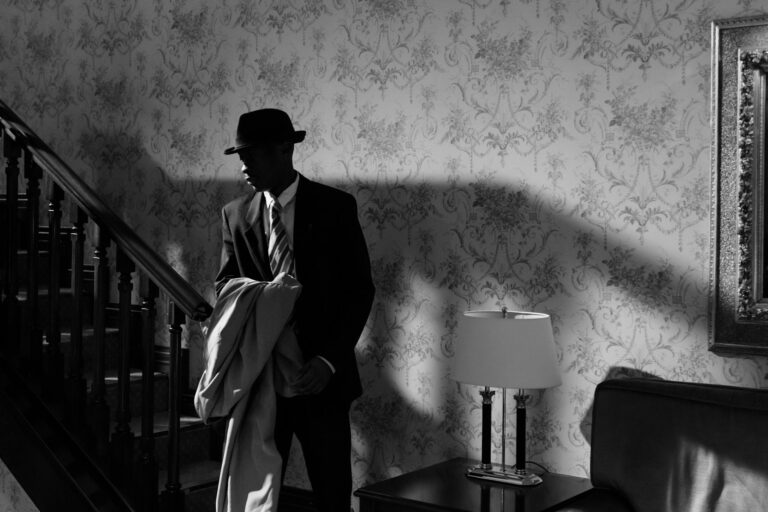
The climax of *The Bourne Identity* (2002) is fundamentally about Jason Bourne’s refusal to return to his life as an assassin. When Bourne finally confronts Alexander Conklin, the former Treadstone director pursuing him throughout the film, he doesn’t engage in the expected lethal combat. Instead, Bourne warns Conklin to leave him alone and walks away, representing a deliberate rejection of the violent identity imposed on him. This moment defines the entire film’s thematic arc: Bourne’s struggle is not external but internal, a battle to reclaim his humanity against a government machinery designed to strip it away. The climax unfolds across two locations.
The immediate confrontation happens in Paris with Conklin, but the true resolution occurs when Bourne tracks Marie to a tourist café on the Greek island of Mykonos. Their reunion provides the film’s emotional resolution, suggesting that Bourne’s escape from his past might actually be possible. This structure—rejection of the violent life followed by reconnection to human relationship—distinguishes Bourne’s story from typical espionage narratives where the protagonist either embraces their role or dies in the attempt. Director Doug Liman made a deliberate creative choice to keep the climax character-driven rather than action-spectacle driven, resisting pressure from early test audiences who wanted scenes of mass destruction and conventional heroic triumph. This restraint elevated the film beyond standard spy-thriller conventions.
Table of Contents
- Why Bourne Refuses to Kill Conklin
- The Assassination That Reveals the Conspiracy
- The Greek Island Reunion and Domestic Resolution
- Doug Liman’s Restraint Against Action-Spectacle Pressure
- The Tension Between Escape and Recapture
- Marie as the Anchor to Humanity
- The Deliberate Ambiguity of Success
Why Bourne Refuses to Kill Conklin
The confrontation between bourne and Conklin represents an ideological clash between two men who understand Treadstone from opposite vantage points. Conklin created the program and built his career on it; he cannot fathom why Bourne would reject the power, resources, and identity that Treadstone provided. To Conklin, Bourne’s resistance is irrational, a form of ingratitude toward the system that made him extraordinary. But Bourne has experienced the cost of that transformation: the fragmented memory, the compulsion to violence, the inability to trust or connect with anyone.
By refusing to kill Conklin, Bourne breaks the cycle of violence that Treadstone perpetuates. A conventional action film would escalate this confrontation into a climactic battle, but *The Bourne Identity* presents a different kind of strength—the strength to walk away. Bourne’s warning to Conklin (“Do not come after me again”) is not an empty threat; it’s a declaration of independence. It signals that Bourne has determined his own terms of engagement, which is precisely what Treadstone never allowed him to do.
The Assassination That Reveals the Conspiracy
What makes the climax structurally complex is that Bourne’s refusal to kill Conklin doesn’t prevent Conklin’s death. Moments after Bourne leaves, an assassin known as Manheim or Russell Levy shoots Conklin, revealing a crucial layer of the conspiracy that has been operating throughout the film. This death isn’t Bourne’s doing; it’s an act orchestrated by higher authority—CIA Deputy Director Ward Abbott, played by Brian Cox. This plot development exposes the hierarchy of Treadstone. Conklin, while ruthless, was operating within an official framework, taking orders from Abbott. When Conklin becomes a liability—when his pursuit of Bourne and his desperate desire to recapture his wayward asset threaten to expose the program—he’s eliminated by the very system he served.
The irony is brutal: Conklin is killed not by his creation, but by his superior, the same superior he believed authorized his hunt for Bourne. This revelation complicates any simple reading of good versus evil; Abbott represents a government that protects its secrets more fiercely than it protects its agents. For audiences, Conklin’s death can feel anticlimactic because we expect Bourne to be the agent of that death. But that anticlimax is precisely the point. Treadstone is larger and more impersonal than any individual conflict. Bourne is not battling Conklin for supremacy; he’s trying to escape from a machine that will consume everyone in its path, including the men who built it.
The Greek Island Reunion and Domestic Resolution
The final scene relocates the action to Mykonos, Greece, a sunny Mediterranean island that visually and thematically contrasts with the gray, rainy European cities where Bourne has been hunted. Bourne finds Marie in a tourist café, apparently unaware that he has been searching for her. This reunion is shot with quiet tenderness—no explosions, no confrontations, just two people recognizing each other in a moment of temporary safety. This reunion serves multiple narrative functions. First, it confirms that Marie survived the events of the film, giving Bourne’s emotional journey a stake and reward.
Second, it suggests the possibility of a normal life, however temporary, away from the machinery of espionage. The café is populated with ordinary tourists, indifferent to the drama that has consumed Bourne’s recent past. Marie, notably, doesn’t ask him questions about what he’s done or where he’s been; she simply accepts his presence, which implies she understands at some level that Bourne has been through something that resists explanation. The Mykonos setting is not accidental. Greece offers Bourne temporary asylum in a place where American intelligence apparatus feels distant. The island functions as a liminal space, neither fully Bourne’s destination nor a definitive endpoint, suggesting that his freedom is fragile and contingent.
Doug Liman’s Restraint Against Action-Spectacle Pressure
Director Doug Liman faced a significant creative tension during post-production: test audiences wanted more action, more elaborate fight sequences, more visual destruction. Early screenings revealed that viewers expected the climax to escalate dramatically, with Bourne deploying his full range of combat skills in a spectacular finale. Liman resisted this pressure because it would have undermined the film’s core exploration of Bourne’s psychological and moral crisis. The choice to keep the climax intimate and character-focused proved crucial to the film’s success and legacy. By refusing to turn the climax into a conventional action sequence, Liman established that *The Bourne Identity* was interested in something deeper than fight choreography or visual spectacle.
Bourne’s power lies not in his physical dominance but in his determination and his capacity to make a choice that defies his conditioning. The absence of a final battle is itself a statement about who Bourne has become: someone capable of walking away from violence. This restraint also distinguished *The Bourne Identity* from the spy-thriller films that preceded it. In earlier James Bond films, for instance, the climax features elaborate setpieces where the hero defeats the villain through superior skill and resources. Here, Bourne defeats Treadstone by opting out of the competition entirely. Liman’s directorial vision understood that this refusal would resonate more powerfully than any choreographed action sequence.
The Tension Between Escape and Recapture
One of the climax’s underlying tensions is the question of whether Bourne’s escape is actually permanent or merely temporary. The film ends on a note of tentative optimism—Bourne and Marie are together in Greece, seemingly safe—but the narrative has not provided any assurance that Ward Abbott and the CIA apparatus will stop hunting him. The authorities know Bourne’s identity; they have resources; they have demonstrated their willingness to eliminate anyone who becomes a liability. This ambiguity is a limitation of the climax if you’re seeking closure.
Unlike many action thrillers that conclude with the protagonist’s enemies definitively vanquished or the protagonist achieving complete safety, *The Bourne Identity* ends with Bourne still technically a fugitive. The happiness of the reunion is shadowed by the knowledge that this peace could be interrupted at any moment. The film trusts viewers to accept this uncertainty rather than demanding a false sense of resolution. Subsequent sequels would explore this tension—the reality that Bourne’s escape is never truly complete, that Treadstone and its successors will continue pursuing him. But the original film leaves this question unresolved, suggesting that Bourne’s victory is measured in psychological terms (his reclamation of agency) rather than in the practical terms of conventional thriller narratives.
Marie as the Anchor to Humanity
Marie Kreutz (Franka Potente) functions in the climax as the representation of normal human connection, the only person in Bourne’s recent life who has demonstrated unconditional acceptance of him despite his dangerous nature. Their reunion emphasizes this contrast: the café is full of ordinary people enjoying ordinary lives, and Marie is part of that world. By finding Marie, Bourne is locating the one person who has offered him a glimpse of what life could be outside of Treadstone’s shadow.
The scenes with Marie also illustrate what Bourne is fighting for when he refuses to return to being an assassin. He’s not fighting for freedom in abstract terms; he’s fighting for the possibility of specific, intimate human connection. Marie represents the antithesis of Treadstone—she asks no questions, demands no obedience, and offers only her presence. This simplicity is radical in the context of Bourne’s experience, where every relationship has been instrumental and conditional.
The Deliberate Ambiguity of Success
The climax deliberately leaves open the question of whether Bourne has actually succeeded or merely postponed the inevitable. He has escaped immediate pursuit, warned Conklin to stop following him, and found Marie again. But these victories are tactical rather than strategic. Ward Abbott remains in power; the CIA still exists; Bourne’s identity and location are no longer secrets.
The film refuses to signal through conventional cinematic language that this is a “happy ending” in the traditional sense. This refusal to provide complete resolution was the film’s most consequential artistic choice. It established that the Bourne films would explore a form of heroism fundamentally different from conventional action-adventure narratives: not triumph, but survival; not victory, but the exercise of choice in impossible circumstances. The final image of Bourne and Marie together in Greece is less a conclusion than a moment of respite within an ongoing struggle, a reminder that for people like Bourne, peace is always provisional and freedom always contested.