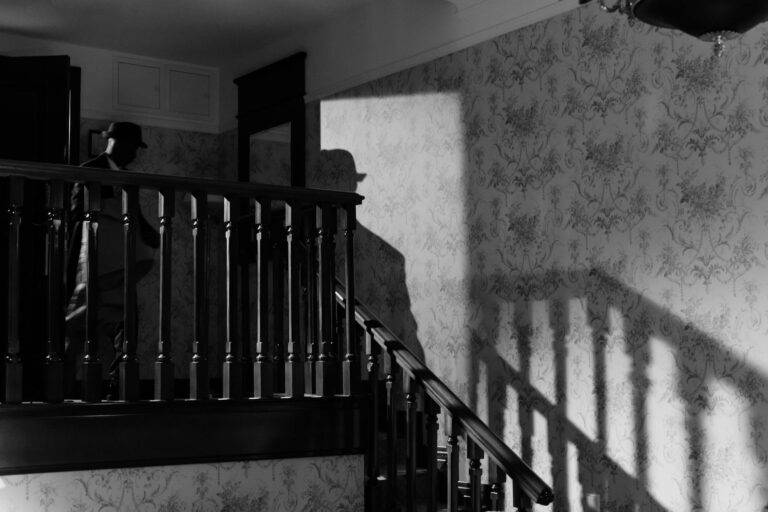
The climax of *The Beast with Five Fingers* (1946) reveals a shocking truth that inverts the entire narrative: the disembodied hand is not a supernatural killer at all, but rather a manifestation of Hilary Cummins’s fractured mind. When Julie Holden finally discovers the reality, it emerges that Cummins—portrayed with haunting intensity by Peter Lorre—is the actual murderer, having orchestrated the crimes to protect his obsessive book collection. This revelation transforms what has played as a Gothic horror film into a psychological study of delusion and obsession, a twist that was relatively sophisticated for 1946 audiences expecting straightforward supernatural scares.
The brilliance of director Robert Florey’s climax lies in how it holds two interpretations in tension even after the truth is unveiled. Cummins has convinced himself so completely that the severed hand acts with independent will that the line between his deliberate actions and his psychological breakdown becomes impossible to parse definitively. This ambiguity—whether the hand truly crawls of its own accord or whether Cummins’s deteriorating mental state creates the illusion—persists even as the rational explanation emerges, leaving viewers uncertain whether they have just witnessed a return to reality or merely entered deeper into madness.
Table of Contents
- How Hilary Cummins’s Obsession Led to Murder
- The Supernatural Manifestation and Its Psychological Reality
- The Role of Music in Anchoring the Climax
- How Cummins Used Practical Deception to Commit Murder
- The Question of Cummins’s Psychological State at the Climax
- The Climactic Visual of the Hand in the Fire
- The Darkly Comic Resolution and Its Subversive Ending
How Hilary Cummins’s Obsession Led to Murder
Hilary Cummins is introduced as a seemingly pathetic figure, a piano teacher who has devoted his life to collecting rare manuscripts and first editions. His financial desperation and his fierce attachment to his library create the motive for murder—he kills not for wealth or passion, but to protect the books he treasures above human life. The specificity of his crime selection reveals the twisted logic of his mind: he targets individuals connected to the estate of his former patron, Andrea Ingram, whose widow controls the library he covets. This is murder driven not by revenge or greed in any conventional sense, but by what amounts to artistic obsession gone pathological.
What makes Cummins a more unsettling villain than a typical murderer is precisely this absence of rational motive as audiences typically understand it. He is not a hardened criminal or a man driven by lust or money. Instead, Cummins represents the danger of allowing any single passion—even something as seemingly civilized as book collecting—to consume one’s entire moral framework. His need to possess these volumes overrides his capacity for empathy or restraint, transforming him into a killer whose actions follow a logic that is internally consistent but utterly divorced from normal human values. This psychological profile was progressive for its era, predating by decades the widespread popularity of studying criminal psychology in mainstream cinema.
The Supernatural Manifestation and Its Psychological Reality
The central visual horror of the film—the disembodied hand that crawls, grasps, and seemingly acts with independent malevolence—reaches its culmination when Cummins, in a moment of panic or clarity, throws the severed hand into a fireplace. What follows is perhaps the most unsettling sequence in the film: the hand, engulfed in flames, crawls out of the fire and appears to strangle Cummins before fading away or vanishing entirely. This moment operates simultaneously as a literal event (if we accept the supernatural framework) and as a hallucination born from Cummins’s disintegrating psyche.
The danger of accepting any single interpretation too confidently is that the film deliberately refuses to resolve this ambiguity completely. By the time the rational explanation emerges—that Cummins himself severed and manipulated the hand, using remote-triggered music and strategic placement—the hand’s appearance in the fire has already lodged itself in viewers’ minds as uncanny and almost certainly preternatural. Florey’s decision to maintain this uncertainty even after the mystery is technically “solved” distinguishes *The Beast with Five Fingers* from straightforward whodunits. It suggests that the psychological truth about Cummins is actually more disturbing than any ghost story could be: his mind has fractured to the point where he genuinely experiences the hand as autonomous, regardless of the objective facts of his own actions.
The Role of Music in Anchoring the Climax
As Cummins descends into the final confrontation with the hand he has created and imprisoned in his own mind, the soundtrack becomes dominated by Bach’s “Chaconne in D Minor” as transcribed by Brahms. This piece, performed with one hand throughout the sequence, becomes a kind of psychological anchor point for the horror. The musical choice is not incidental—Bach’s Chaconne is a virtuosic piece that demonstrates the full range of what a single hand can accomplish, making it a darkly ironic accompaniment to a story obsessed with a severed hand’s supposed agency. The comparison to *The Cabinet of Dr.
Caligari* (1920), which critics have noted regarding the mood and visual style of this sequence, extends to the use of music and sound as tools of psychological manipulation. Both films use their soundscapes to pull viewers into fractured, unreliable perspectives. The piano music performed with one hand creates a haunting, almost mournful quality that transforms the horror from the external (a supernatural threat) to the internal (a man’s torment within his own consciousness). The single-hand performance becomes metaphorically dense: it is simultaneously the music that Ingram’s ghost might have played, the music Cummins himself would perform, and the music that scores the hand’s apparent independence.
How Cummins Used Practical Deception to Commit Murder
When Commissario Castanio and Conrad finally piece together the truth, they discover that Cummins’s method was far more calculated and mundane than the supernatural narrative suggested. He had severed the hand (likely from a recently deceased person or a cadaver he obtained) and stored it strategically at various locations around town. To create the illusion that the hand was operating independently and to provide an alibi for his own whereabouts, Cummins had hidden a record player that could be remotely triggered to play Ingram’s recorded piano music. The brilliance of this scheme lies in how it exploits the psychology of the witnesses—and the audience.
By creating a sensory event (the music) that seems to occur mysteriously and placing the severed hand at the crime scenes, Cummins weaponizes people’s natural inclination toward supernatural explanation. The record player becomes a kind of Victorian technology for gaslighting: Cummins manufactures what appears to be evidence of a supernatural force while actually committing very human, very premeditated murders. This practical method is almost more disturbing than magic would be because it requires patience, planning, and a clear understanding of how to manipulate perception. Cummins is not insane in the sense of being incapable of reason; he is insane in his conviction that this elaborate scheme is justified by his need to protect his books.
The Question of Cummins’s Psychological State at the Climax
By the time the climax arrives, it becomes genuinely unclear whether Cummins is still operating from deliberate calculation or whether he has lost the ability to distinguish his own actions from the hand’s supposed autonomy. His mind has degraded to the point where his own careful deceptions have become, to him, indistinguishable from supernatural reality. This creates a vertiginous effect: was Cummins always mad, carefully planning murders while in the grip of delusion, or did the delusions develop as a result of his crime and his need to rationalize what he has done? One of the film’s strengths is that it resists providing a clear diagnosis or timeline for Cummins’s mental deterioration.
The viewer is left with only the observable facts: he has killed to protect his library, he has created an elaborate and half-believable cover story involving a severed hand, and by the climax, he appears genuinely terrified of the hand he has created. Whether this terror represents continued manipulation or genuine psychotic experience remains intentionally murky. The limitation of this approach is that modern audiences, accustomed to psychological thrillers that neatly categorize their villains’ pathologies, may find the refusal to explain Cummins more frustrating than ambiguous. Florey’s commitment to maintaining psychological uncertainty is admirable but costs some clarity.
The Climactic Visual of the Hand in the Fire
The moment when Cummins hurls the severed hand into the fire should, logically, end the supernatural threat immediately—a severed hand cannot survive burning. Yet this is precisely when the horror intensifies rather than resolves. The hand, engulfed in flames, crawls out of the fireplace toward Cummins and appears to strangle him.
Whether this is Cummins’s hallucination finally consuming him completely, whether he is throwing himself into the fire in a final act of psychotic breakdown, or whether something genuinely supernatural has been occurring remains devastatingly unclear. This sequence draws visual and thematic power from the fundamental impossibility it presents: we are watching something that cannot logically occur being rendered with complete seriousness. The hand’s movement through fire violates both natural law and the rational explanation that has just been offered to us, forcing viewers to choose between accepting supernatural agency or recognizing that we are watching the unraveling of a mind. The choice itself becomes irrelevant because the visual result is identical either way.
The Darkly Comic Resolution and Its Subversive Ending
After the psychological and visual horror of the climax, the film concludes with a tonal shift that many viewers find jarring: a caricatured Italian police detective turns directly to the camera and addresses the audience in exaggerated accent, asking with comedic incredulity, “Can you imagine a hand walking around?” This epilogue seems designed to break the spell of the horror, to reassure audiences that reason has prevailed and the supernatural has been definitively debunked. Yet the comedy feels hollow and slightly mocking, as though Florey is suggesting that no rational explanation can truly undo the terror that has preceded it. This final scene, with its almost vaudeville tone, undercuts any sense of orderly resolution.
The detective’s rhetorical question—posed in a dialect that borders on the minstrelsy conventions of 1940s cinema—can be read as Florey’s commentary on the audience’s own desire for rational closure. We want the detective to explain everything, to restore order and sense, but the film’s true ending remains the psychological horror of the climax, not this reassuring but ultimately hollow dismissal. The hand has already walked around, at least in the minds of everyone who has witnessed the film, and no amount of comedic deflation can fully dispel that image.
- —