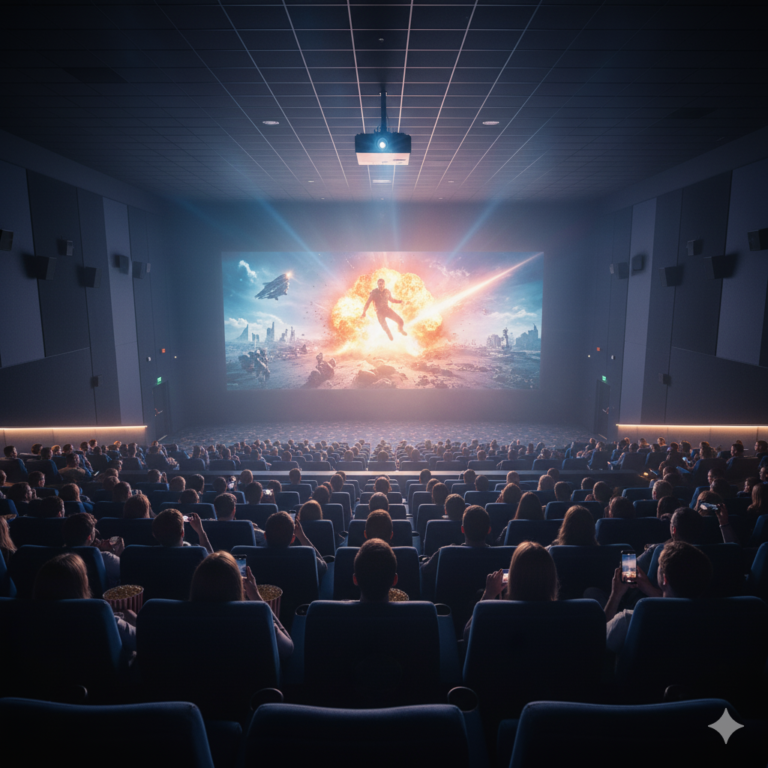
The 2026 film calendar is stacked with movies that grapple directly with technology’s grip on modern life, and several of them are already generating serious buzz. Gore Verbinski’s “Good Luck, Have Fun, Don’t Die,” now streaming, has been called one of the best films of early 2026 for its sharp argument that the real danger of AI is not some distant robot uprising but the quiet, incremental ways algorithms reshape human behavior — students numbed by screens, corporations monetizing grief, communities outsourcing decision-making to machines. That film alone would make 2026 a notable year for tech-themed cinema, but it is far from the only entry.
From a Luca Guadagnino-directed biographical comedy-drama about the real-life firing and rehiring of OpenAI CEO Sam Altman, to a Sundance-premiered documentary wrestling with AI’s existential implications, to a Chris Pratt thriller about an AI judge that can sentence you to death, filmmakers are treating technology not as window dressing but as the central dramatic question of our time. Add in the fact that two AI-generated films have qualified for the 2026 Oscars race, and that the world’s first AI-directed feature is on the horizon, and you get a year where the line between movies about technology and movies made by technology has become genuinely blurred. This article breaks down the most significant 2026 releases exploring technology’s impact, examines what classic films set in 2026 actually got right, and considers what all of this means for the future of filmmaking itself.
Table of Contents
- Which 2026 Movies Tackle Artificial Intelligence Head-On?
- The Sam Altman Movie and Hollywood’s New Obsession With Real Tech Stories
- Sci-Fi Blockbusters Exploring Science and Technology Themes
- What Classic Movies Set in 2026 Got Right and Wrong
- AI-Made Films and the Oscars Question
- Gore Verbinski’s Case Against the CGI Pipeline
- What 2026’s Tech Films Signal About the Future of the Genre
- Conclusion
- Frequently Asked Questions
Which 2026 Movies Tackle Artificial Intelligence Head-On?
The most direct confrontation with AI on screen this year comes from “Good Luck, Have Fun, Don’t Die,” directed by Gore Verbinski and starring Sam Rockwell, Haley Lu Richardson, Juno Temple, Michael Pena, and Zazie Beetz. The premise — a visitor from the future leads diner patrons on a mission to prevent the unregulated rise of AI — could easily devolve into schlocky sci-fi, but critics have praised the film for its restraint. The script’s core thesis is that the danger is not Skynet; it is the way algorithms quietly corrode human autonomy. Verbinski himself remarked in a November 2025 interview that “CGI no longer looks good,” signaling his broader skepticism toward the tech industry’s influence on Hollywood’s visual pipeline. Then there is “Mercy,” released in January 2026 and starring Chris Pratt and Rebecca Ferguson.
Set in a near-future where a detective has 90 minutes to prove his innocence to an advanced AI judge or face execution, the film turns algorithmic decision-making into a literal life-or-death scenario. It currently holds a 6.1 on IMDb — not a critical darling, but a solid genre entry that makes the surveillance state feel personal and claustrophobic rather than abstract. On the documentary side, “The AI Doc: Or How I Became an Apocaloptimist” premiered at Sundance on January 27, 2026, and arrives in theaters on March 27, 2026, via Focus Features. Directed by Daniel Roher, the filmmaker behind “Navalny,” and produced by Daniel Kwan and Jonathan Wang of “Everything Everywhere All at Once” fame, the film interviews leading voices on both sides of the AI debate while Roher grapples with the risks as a father-to-be. It holds an 82% on Rotten Tomatoes from 11 critics and an 8.2 on IMDb, making it one of the best-reviewed films of the year so far.

The Sam Altman Movie and Hollywood’s New Obsession With Real Tech Stories
Perhaps the most audacious entry on the 2026 slate is “Artificial,” directed by Luca Guadagnino and written by Simon Rich. Andrew Garfield stars as OpenAI CEO Sam Altman in a biographical comedy-drama centered on the real-life november 2023 boardroom coup that saw Altman fired and then swiftly rehired. Monica Barbaro, Cooper Koch, Jason Schwartzman, and Ike Barinholtz round out the cast, and the film will also depict Elon Musk. It is produced by Amazon MGM Studios, with a 2026 release date still to be confirmed. The fact that a director known for sensual, aesthetically rich films like “Call Me by Your Name” and “Challengers” is making a movie about a corporate power struggle at an AI company tells you something about where Hollywood sees the drama in Silicon Valley right now.
This is not a cautionary tale about robots — it is a story about ego, governance, and who gets to steer the most powerful technology ever built. The comparison to “The Social Network” is inevitable, though the tone may skew more satirical given Rich’s comedy background. However, biographical films about living tech figures carry real limitations. Altman, Musk, and the OpenAI board members are all still active and litigious. The film will need to walk a careful line between dramatic license and factual accuracy, and audiences should expect some composite characters and compressed timelines. Whether Guadagnino can capture the genuine paranoia and ideological conflict inside OpenAI without reducing it to a simple hero-villain narrative remains the open question.
Sci-Fi Blockbusters Exploring Science and Technology Themes
Beyond the films explicitly about AI, 2026 features a murderer’s row of science fiction that uses technology and scientific discovery as its dramatic engine. “Project Hail Mary,” starring Ryan Gosling and directed by Phil Lord and Christopher Miller, adapts Andy Weir’s bestselling novel about a science teacher sent on a last-ditch space mission to save humanity. Scheduled for March 2026, it has been described as a potential Q1 blockbuster and carries the kind of problem-solving optimism that made “The Martian” a cultural event. Steven Spielberg returns to sci-fi with “Disclosure Day,” tackling government conspiracies, alien signals, and the societal impact of revealing extraterrestrial contact. This is notable in part because Spielberg and Ridley Scott are both releasing sci-fi films in the same year for the first time since 1982, when “E.T.
the Extra-Terrestrial” and “Blade Runner” debuted within weeks of each other. Scott’s entry is “The Dog Stars,” starring Jacob Elordi and Josh Brolin, releasing March 27, 2026, and based on Peter Heller’s novel about pandemic survivors confronting alien invaders. Even the animated slate is in on the act. “Hoppers,” directed by Daniel Chong and releasing March 6, 2026, follows a college student whose consciousness is transferred into a robotic beaver, sparking an animal uprising. It plays the technology-and-consciousness theme for comedy, but the premise — what happens when the boundary between human awareness and machine bodies dissolves — is the same question serious sci-fi has been asking for decades.

What Classic Movies Set in 2026 Got Right and Wrong
One of the more fascinating exercises this year is evaluating the predictions made by films that were actually set in 2026. Fritz Lang’s “Metropolis,” released in 1927 and set in 2026, depicted a dystopia with massive income inequality, where the wealthy live in skyscrapers while workers toil underground to power the city. The film predicted that technology would exacerbate class divides rather than flatten them — a thesis that, given the current state of the tech industry’s wealth concentration, reads as uncomfortably prescient. Where it missed was the specifics: Lang imagined literal underground labor, while the modern equivalent is gig workers and content moderators hidden behind apps and algorithms. “Dawn of the Planet of the Apes,” released in 2014 and set in 2026, imagined a world where a simian flu pandemic had wiped out most of humanity while apes gained intelligence through biotech experiments.
The pandemic prediction gained eerie relevance after COVID-19, though the scale and nature of the real-world pandemic differed significantly. The biotech angle — the idea that our attempts to enhance intelligence could backfire catastrophically — remains a live concern in an era of gene editing and neural interfaces. The tradeoff in evaluating these predictions is between specificity and spirit. The films that predicted exact technologies (flying cars, humanoid robots) tend to look foolish. The films that predicted societal dynamics — inequality, pandemic vulnerability, the unintended consequences of biological research — tend to look prophetic. The lesson for current filmmakers: the technology itself dates quickly, but the human response to it is timeless.
AI-Made Films and the Oscars Question
A development that would have seemed absurd five years ago is now reality: two AI-made films, “Ahimsa” and “All Heart,” qualified for the 2026 Oscars race, marking a milestone in AI-generated content competing for major industry awards. Whether they will receive nominations is another matter entirely, but their qualification alone forces the Academy and the broader industry to confront questions they have been deferring. Separately, “The Sweet Idleness” is being positioned as the world’s first AI-directed feature film, built around “FellinAI,” an AI agent designed to function not just as a production tool but as an actual director, generating poetic, dreamlike sensibilities akin to European arthouse cinema. The ambition is striking, but the limitations are real.
AI can generate imagery and sequence shots, but directing involves eliciting performances, making emotional judgments in real time, and understanding what a story needs at a gut level that current systems cannot replicate. Whether the finished film feels like art or a tech demo will say a great deal about where this technology actually stands versus where its proponents claim it stands. The warning here is for audiences and critics alike: the conversation around AI-made films tends to collapse into binary positions — either AI is about to replace human filmmakers, or it is a gimmick incapable of real art. The reality, as with most technological shifts, will likely be messier and more gradual than either camp expects.
Gore Verbinski’s Case Against the CGI Pipeline
Verbinski’s comment that “CGI no longer looks good” is worth dwelling on because it reflects a growing discomfort among filmmakers with the visual effects pipeline that has dominated Hollywood for two decades. The issue is not that digital effects are inherently inferior, but that the economic pressures of blockbuster filmmaking — tight deadlines, overburdened VFX houses, an arms race for spectacle — have degraded the quality of the finished product. Audiences have noticed.
The backlash against “volume” and green-screen-heavy productions has been building for years. What makes this relevant to the technology-impact conversation is that AI is being positioned as the solution to this very problem — faster rendering, cheaper effects, automated compositing. But if the underlying issue is an industry that treats visual effects artists as expendable and prioritizes speed over craft, layering AI on top of a broken system may simply accelerate the same problems Verbinski is diagnosing.
What 2026’s Tech Films Signal About the Future of the Genre
The sheer density of technology-focused films in 2026 suggests that Hollywood has moved past the era of treating AI and tech as niche sci-fi flavoring. These are mainstream releases from major directors — Spielberg, Scott, Guadagnino, Verbinski — not indie curiosities. The stories being told are also more specific and grounded than the Terminator-style narratives of previous decades. Films like “Good Luck, Have Fun, Don’t Die” and “Mercy” are not asking whether machines will become sentient.
They are asking what happens to ordinary people when institutions hand decision-making to algorithms. If this trend holds, expect the next wave of tech-themed films to move even further from spectacle and closer to domestic drama. The most frightening technology stories are not about extinction events. They are about a parent discovering their child’s school uses an algorithm to determine disciplinary outcomes, or a worker realizing their performance review was written by software. The 2026 class of films is pointing in exactly that direction.
Conclusion
The 2026 film landscape represents a turning point for how cinema engages with technology. From Verbinski’s anti-AI satire to Guadagnino’s OpenAI boardroom drama, from a Sundance documentary holding an 8.2 on IMDb to the first AI-made films qualifying for Oscar consideration, the conversation has shifted from speculative fiction to something far more immediate and personal.
These films are not asking what technology might do someday — they are asking what it is doing right now, and whether anyone is paying attention. For audiences, the practical takeaway is straightforward: 2026 is one of the richest years in recent memory for films that take technology seriously as a subject rather than using it as set decoration. Whether you are drawn to the blockbuster spectacle of “Project Hail Mary,” the satirical edge of “Good Luck, Have Fun, Don’t Die,” or the documentary rigor of “The AI Doc,” there is a film on this year’s calendar that will challenge how you think about the machines in your pocket and the algorithms shaping your daily life.
Frequently Asked Questions
What is the best-reviewed technology-themed movie of 2026 so far?
“The AI Doc: Or How I Became an Apocaloptimist,” directed by Daniel Roher, holds an 82% on Rotten Tomatoes and an 8.2 on IMDb. It premiered at Sundance on January 27, 2026, and hits theaters March 27, 2026.
Is there really a movie about Sam Altman and OpenAI?
Yes. “Artificial” is directed by Luca Guadagnino and stars Andrew Garfield as Altman. It focuses on the November 2023 boardroom firing and rehiring and will also depict Elon Musk. It is produced by Amazon MGM Studios with a 2026 release date yet to be confirmed.
Have AI-generated films actually qualified for the Oscars?
Two AI-made films, “Ahimsa” and “All Heart,” qualified for the 2026 Oscars race, though qualification and nomination are different things. Their eligibility marks a significant industry milestone regardless.
Where can I watch “Good Luck, Have Fun, Don’t Die”?
The film, directed by Gore Verbinski and starring Sam Rockwell, is currently streaming. It has been widely praised as one of the best films of early 2026.
What old movies were actually set in 2026?
Fritz Lang’s “Metropolis” (1927) and “Dawn of the Planet of the Apes” (2014) are both set in 2026. “Metropolis” predicted technology-driven class inequality, while “Dawn” imagined a post-pandemic world shaped by biotech experiments gone wrong.