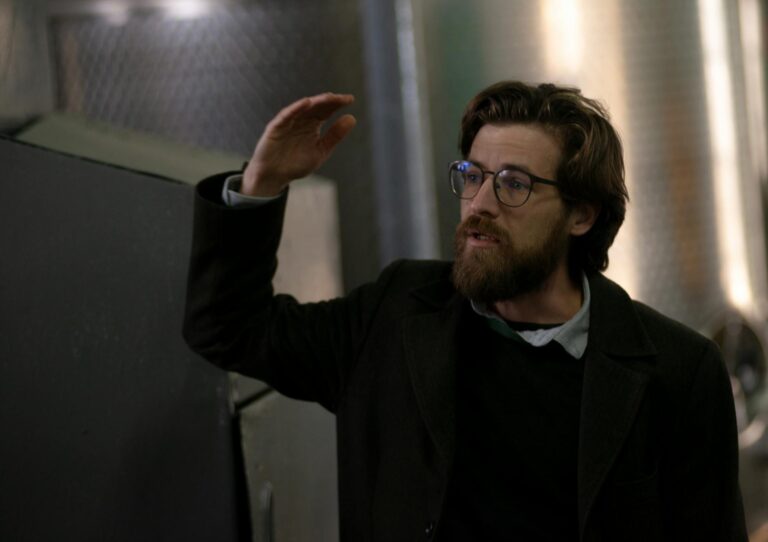
Memento’s final scene occurs at the film’s chronological beginning, where Leonard Shelby shoots a man he believes is John G, the person responsible for his wife’s death. What makes this ending devastatingly complex is that Leonard is both right and completely wrong—he does kill someone named “G” (Teddy), but Teddy is not the man who murdered his wife. Teddy is a corrupt police officer who has systematically manipulated Leonard’s memory loss for years, using him as a tool to eliminate criminals while Leonard chases a false vengeance. The scene plays out with Leonard executing Teddy in a parking garage while convinced he’s solving his wife’s murder, when in fact he’s committing another act of violence based on manufactured evidence he himself has created. The final scene is also a confession of sorts.
Before killing Teddy, Leonard learns—or is told—the full truth: his wife survived the attack that killed her attacker, but Leonard himself administered a fatal insulin overdose to her weeks later, unable to accept that her memory loss was permanent. This revelation destroys the entire narrative Leonard has constructed in his mind, the story that justified his existence and his quest. Yet Leonard chooses to reject this truth. He decides to create new false evidence, to forget what he’s just learned, and to continue hunting an innocent man. The final scene is not a mystery to be solved but a portrait of someone choosing delusion over an unbearable reality.
Table of Contents
- Why Does Leonard Kill Teddy at the Movie’s End?
- Who Is Teddy and Why Does He Matter to Leonard?
- The Revelation That Destroys Leonard’s Quest
- How Christopher Nolan Designed the Ambiguity
- The Confirmation Bias Trap
- Critical Reception and Cultural Significance
- The Disorientation Effect of Reverse Chronology
Why Does Leonard Kill Teddy at the Movie’s End?
Leonard kills Teddy because he has been systematically manipulated into believing Teddy is “John G,” the man who killed his wife. For the entire film—or what appears to be the entire story—Teddy has been guiding Leonard toward this moment, providing him with clues, photographs, and encouragement. Teddy profits from Leonard’s condition by using him as a tool to eliminate drug dealers and criminals, always feeding him information that points toward a false target. Leonard’s short-term memory loss means he cannot remember Teddy’s true nature or their long history together; each time they meet, Teddy can reframe their relationship and steer Leonard toward the next victim.
What makes Leonard’s decision to kill Teddy particularly tragic is that it appears to be an act of will rather than pure confusion. When confronted with evidence of Teddy’s manipulation, Leonard doesn’t simply misunderstand due to his memory condition—he actively chooses to ignore contradictory information and double down on his existing beliefs. He destroys photographs that would expose Teddy, keeps only the evidence that supports his theory, and uses his amnesia as a tool to reinforce his preferred narrative. The film suggests Leonard is not merely a victim of his medical condition but someone who weaponizes his own memory loss to justify violence.
Who Is Teddy and Why Does He Matter to Leonard?
teddy is a corrupt police detective who has known Leonard for years, long before the events of the film. He has discovered that Leonard’s memory condition makes him the perfect unwitting accomplice—someone who can be sent to murder criminals, who will have no memory of his previous kills, and who can be manipulated into believing he’s pursuing a personal vendetta rather than serving Teddy’s purposes. Teddy is not the man who killed Leonard’s wife; he’s a secondary villain who exploits Leonard’s tragedy for profit. The film never fully explains how many people Leonard has killed on Teddy’s behalf, but the evidence suggests it has been more than one.
The limitation of Teddy’s role in the narrative is that viewers only understand his true nature through fragments and contradictions. Teddy tells Leonard one story, then contradicts himself; he provides evidence that doesn’t quite add up; he seems overly invested in Leonard’s investigation. But Leonard’s condition—and the film’s reverse chronology—prevents audiences from ever seeing the full scope of their relationship. The audience is trapped in Leonard’s perspective, seeing only what he sees and forgetting what he forgets. Teddy could be a monster or merely a pragmatist; the film withholds enough information to allow viewers to interpret his character according to their own assumptions about manipulation and culpability.
The Revelation That Destroys Leonard’s Quest
The most devastating piece of information in the entire film comes near its end: Leonard’s wife did not die in the attack that sparked his quest for vengeance. She survived the home invasion, but her memory was damaged along with Leonard’s. Weeks or months later, unable to cope with her permanent amnesia, Leonard administered an insulin overdose to his wife, killing her himself. This fact is presented through Teddy’s account, which is itself unreliable—Teddy may be lying, exaggerating, or telling the truth. But the film provides enough corroborating detail that audiences must seriously consider the possibility that Leonard has been chasing a killer who doesn’t exist because he cannot face the knowledge that he himself is responsible for his wife’s death.
This revelation creates an impossible trap for Leonard’s character. Accepting this truth means abandoning his entire identity and purpose; it means accepting that he is not an avenging angel but a murderer. Leonard’s response is to reject the information, to destroy any evidence of it, and to actively construct new false evidence that will allow him to continue his quest. He literally chooses delusion. By the film’s final scene, Leonard has engineered a situation where he will kill Teddy while believing he’s solving his wife’s murder, all while knowing—at some level—that his entire narrative is false. The warning here is that self-deception can be chosen, not merely inflicted by circumstance.
How Christopher Nolan Designed the Ambiguity
Christopher Nolan has famously refused to provide a definitive explanation of Memento’s ending, stating that offering answers “closes the door on discussion.” Nolan learned early in his career that audiences engage more deeply with stories when they must interpret rather than accept a given truth. He has confirmed one fact—Leonard did kill his own wife—but presented even this revelation through an untrustworthy narrator, maintaining ambiguity about whether it’s true or whether Teddy is lying to hurt Leonard. The film’s reverse-chronological structure is not merely a stylistic choice; it’s essential to the meaning. By showing events backward, Nolan forces audiences to experience Leonard’s disorientation and confirmation bias in real time, living inside his head rather than observing him from outside.
Nolan’s design creates a permanent interpretive mode. The film refuses to step outside Leonard’s perspective and validate any external truth. This means viewers can spend years debating whether Leonard is a victim of his condition, a victim of Teddy’s manipulation, a willing participant in his own delusion, or a murderer who deserves what happens to him. Each interpretation finds support in the film. The trade-off is that this ambiguity frustrates viewers who prefer clear answers, but it also ensures that Memento remains discussable and re-viewable in ways more straightforward narratives are not.
The Confirmation Bias Trap
Memento functions as a psychological examination of confirmation bias—the human tendency to seek, interpret, and remember information in ways that support pre-existing beliefs. Leonard sets out to prove a theory (Teddy killed my wife), and every subsequent action is filtered through that lens. Evidence that contradicts his theory is dismissed or forgotten; evidence that supports it is highlighted and preserved. The film structure mirrors this psychological process, showing audiences only the information Leonard retains, which means viewers experience the same confirmation bias.
We begin to believe Teddy is guilty because Leonard believes it, even as the film plants hints that Leonard is wrong. A critical limitation of Memento as a psychological portrait is that it remains ambiguous about Leonard’s level of consciousness in this process. Is Leonard a victim of his own brain’s limitations, or is he deliberately manipulating himself? The film suggests both simultaneously. Scholars and critics have interpreted the movie as everything from a tragedy about a man destroyed by his condition to a moral tale about a man who uses his condition as an excuse for murder. The film’s genius is that it allows all these interpretations to coexist, making certainty impossible and forcing viewers to recognize how much their own confirmation bias shapes what they believe about Leonard.
Critical Reception and Cultural Significance
Memento premiered at the Venice Film Festival on September 5, 2000, and received its U.S. theatrical release on March 16, 2001. The film was immediately recognized as a significant work, achieving a 93% approval rating on Rotten Tomatoes based on 184 reviews, with an average score of 8.8 out of 10.
Metacritic rated it 83 out of 100, indicating “universal acclaim.” The film earned Academy Award nominations for Best Original Screenplay and Best Film Editing, though it did not win in either category. In 2017, the Library of Congress selected Memento for preservation in the National Film Registry, recognizing it as a work of cultural, historical, and aesthetic significance—a distinction typically reserved for films at least 25 years old. The film’s enduring critical appreciation reflects its achievement in creating a story that remains discussable and interpretable rather than settled. Unlike many acclaimed films that are praised for technical perfection or emotional clarity, Memento is praised for its ambiguity and its ability to generate sustained debate about meaning and interpretation.
The Disorientation Effect of Reverse Chronology
The reverse-chronological narrative structure—where each scene moves backward in time—is not merely a gimmick but a fundamental tool for making audiences experience Leonard’s psychological state. As viewers watch the film, we gain information that feels like progress toward understanding, only to have it contradicted or recontextualized by earlier scenes. We forget details we learned earlier in the film, just as Leonard forgets details from moments ago. We become confused about the order of events, just as Leonard is confused about what he has already done.
This structural choice creates a specific effect: it makes viewers understand, viscerally and not just intellectually, what it means to live with permanent short-term memory loss. It also demonstrates how easily our understanding of events can be shaped by the order in which we encounter information. When Leonard discovers Teddy’s betrayal near the film’s end, it recontextualizes every previous scene, but then the film moves backward and shows us Leonard actively choosing to forget this discovery. We watch him decide to become deluded. The final scene—Leonard shooting Teddy while believing he’s avenging his wife—takes on its full weight only because we have experienced the entire journey backward and then witnessed Leonard consciously erasing the truth from his own mind.